Introduction
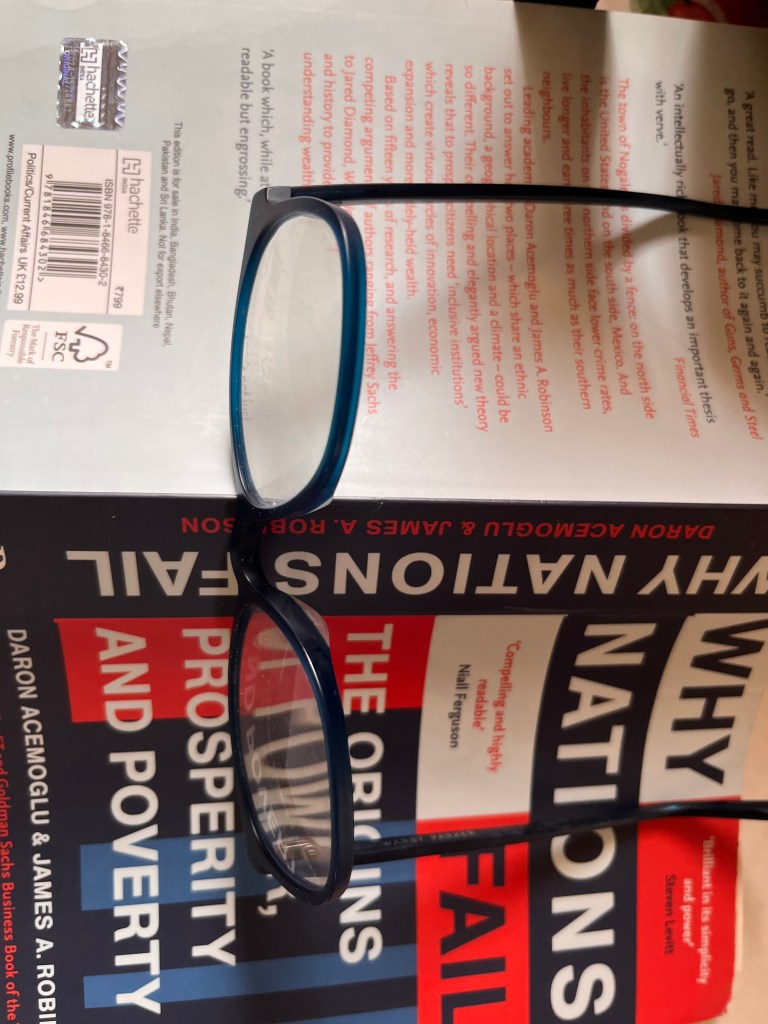
This blog begins by reviewing a classic – Why Nations Fail – the Origins of Power, Prosperity and Poverty by Daren Acemoglu and James A Robinson, and then moves on to more contemporary themes around how ‘civilization erasure’ as a construct is being deployed to bring in authoritarian regimes that would impact prosperity and sovereignty, and lastly what can Indians learn from this global phenomenon.
Part 1
Reviewing: Why Nations Fail
Published in 2012, two professors from MIT and Harvard offer an interesting take on why there is a huge difference between income levels, standards of living, lifespans, and endemic poverty between the rich and the poor nations.
The book is replete with painful but insightful and exhaustive historical narratives ranging from the colonization of South America and Africa, which preceded East India Company by nearly two centuries, exploring economic models of colonization used by the conquistadores – including the Plantation model, and associated modes of governance and policy, to unique perspectives such as how the Plague changed nations differentially. In western Europe, they claim that the black death reduced supply of labor, thereby empowering the survivors to negotiate better wages, and the building of guilds and communities that were ready for industrial revolution much later.
The authors challenge several theories of prosperity versus poverty – some of these were also peddled in the small school that I studied in – including the Geography theory. The Geography theory for example, maintained that countries in the Temperate zones (between 30 and 60 degrees of latitude south and north of equator) are more likely to be prosperous as opposed to the Tropics, because of the climate and soil etc.
The authors offer detailed narratives and this makes the book intriguing and a must read, if you like your blend of history and economics, and like connecting the dots of how western civilization emerged from the dark ages so to speak.
Way back in 2012 – it does feel a long time ago, the authors posit that prosperity is a function of “strong synergistic links between economic and political institutions”, and it becomes critical for political institutions to be inclusive, democratic, fair, and non-extractive. They refer to the virtuous cycle of prosperity and how it is based on the fine balance that the state / governance plays when it comes to forces that seek over-centralization (with prospects of autocracy), extractive, and punitive – where laws of the land are accessible to all including the poor and not selective for the rich.
The book offers a lot more than what has been stated, but I would leave it to your curiosity to peruse further.
What is ironical though, that the authors use USA in most parts, and even UK, as examples of how fair, inclusive, liberal and progressive political and economic institutions can co-exist to sustain prosperity in the west as opposed to autocratic, dictatorial regimes that embraced crony capitalism and in building huge gaps between the rich and the poor. The book was written in early 2000s and published in 2012, and the authors would have never foreseen Brexit, MAGA and other such movements in the subsequent 14 years that have impacted how political institutions have moved, shifted or corroded.
While the authors offer insights on how industrial revolution was leveraged by political and economic institutions differentially between rich and poor nations, we are sitting on another revolution – that of Ai – and the questions loom on the fronts of governance vis-à-vis AI, and how do political and economic institutions ride this tsunami of a wave out. On one hand the AI wave threatens vast unemployment, concentration of wealth and knowledge, and surveillance, there are others who speak of AI changing human well-being for the better.
This leads me to the second theme of Civilization Erasure – that is being flouted as the biggest fear that has led to MAGA in USA, and the rise of nationalistic and xenophobic regimes in developed and prosperous nations of western Europe.
Part 2
The Narrative of Civilization Erasure
“Civilizational erasure” is a 2025-2026 political narrative, notably pushed and endorsed by the Trump Administrationclaiming that Western culture and identity are on the brink of collapse due to immigration, multiculturalism, and government policies. Trump’s speech in Davos this January had many references to this narrative – targeted at gaining support and resonance from nationalistic regimes and autocratic factions in Europe.
While ostensibly this narrative is asserted on Europe and how European policies around mass-scale immigration has resulted in losing one’s identity, the economic decline of the middle class, and a rising majority of the non-White man, the narrative gets deployed for its domestic MAGA strongholds. Trump has been openly racist about it till the Greenland debacle – wanting the Danes and the Swedes apart from White South Africans in the country and deporting the ones from Somalia etc.
If the state / governance policies are imbued with civilizational erasure, it would lead to the state becoming more autocratic or fascist for it would sponsor systemic omission of minority groups including ethnic minorities, women, indigenous people et al. There is evidence of this happening in USA – its attack on women and their rights over their bodies, LGBTQs – the list is long. Critics have pointed out that such narratives may lead to not just oppression but controlling the future by controlling the past.
The Civilization Erasure narrative becomes one more powerful weapon to provoke ‘fears’, ‘angst’ and ‘hate’ – powerful emotions that can transform a liberal democracy into an autocratic regime – for people would want a ‘macho and hypermasculine’ leader who can rescue the majority from the clingy, viral, polluted, and dysfunctional minorities. The focus is on how the past was glorious, and how religious leaders and strong kings were responsible for the creation of such glorious civilizations.
Fareed Zakaria today has challenged this narrative of Civilization Erasure this morning of the Ground Hog Day, echoing what Acemoglu and Robinson have researched in their book. Zakaria has asked an important question – what has made USA a developed and prosperous nation – and has linked its success to inclusive governance, fair democracies, and most interestingly – the Magna Carta – a threshold that seeded the rights to individual property, the separation of the Church from the King, and many other aspects that laid the foundation for western democracies.
I mention Ground Hog day because Civilization Erasure is not a contemporary term – it has been a stratagem used by autocratic and dictatorial regimes for centuries – these include the researched narratives of Acemoglu and Robinson when they speak of the Spanish conquest of South America in the 1500s, where there was a brutal destruction of Aztec and Inca civilizations by burning their written traditions, massacres of the intellectuals etc.
As recently in 1970s, the Khmer Rouge regime, under Pol Pot attempted a radical social “purification” by targeting intellectuals and ethnic minorities, destroying most of the country’s temples, burning books, and forbidding traditional practices in a comprehensive campaign of cultural and physical genocide.
Part 3
Democratic, Inclusive, Fair, and Non-extractive Political and Economic Institutions in India – Apprehensions and Anxieties
Some sections of India have been deploying the narrative of civilizational erasure in the name of Hindu Culture – this government has encouraged the renaming of cities and towns for example, as a way of gaining the past glory of India and by erasing any cultural heritage offered by Islamic kings and their patronage.
India has seen prosperity and poverty across its history – there have been ages and epochs of prosperity, and there have been periods of fragmentation, decline, darkness etc. The gap between the early Vedic Age and the Later Vedic Age is most illustrative (for we had not yet seen the rampaging and marauding Mughals who brought darkness and evil with them). The reason that I take this example is that the Later Vedic Age witnessed a shift from Pastoral economy to an Agrarian economy – a tumultuous transformation comparable to how we are progressing towards the claims of an AI driven economy driving manufacturing 4.0.
In the Early Vedic period (1500 to 600 BCE):
- The governance was tribal and the tribal chief or Rajan was not a territorial monarch – and shared power with democratic assemblies like Sabha (Elders) and Samiti (General Assembly) – which is why we claim that democracy was borne in India.
- The social structure of the early Vedic age was more egalitarian
- The Varna system was fluid and based on occupational competencies as opposed to birth. (On a lighter vein, this era must have seen great HR leaders who would have worked on competencies, assessment and development.)
- Importantly, women enjoyed a higher status – participating in politics and religious institutions – this piece of data is extremely important.
- And lastly religion and spirituality was owned by the householder – the rituals were simple, there were no large temples etc.
The later Vedic Age (1000-600 BCE) saw interesting shifts – these shifts not just saw larger kingdoms and the emergence of complex rituals like the Ashwamedha by more powerful to assert sovereignty over lesser kingdoms, but a more rigidification of social structure – the status of women declined, rituals and religions became more complex, expensive and got dominated by the powerful priestly class, and a rigid caste system, as agrarian economies desired.
Given that India has had a lion’s share of Kings (Hindu, Buddhist, and Islamic) who have built democratic institutions, inclusive systems, and fair governance – it becomes important to look at Prosperity versus Poverty dialogue.
I am more of a progressive liberal who would support economic and political institutions that are democratic, decentralised, inclusive, and policy driven as opposed to autocratic regimes corrupted by crony capitalism and yet maintaining a façade of market capitalism and its claims of fairness.
It is equally important that we question the ludicrousness and violence of narratives that some powerful elites are spreading – where on one hand they speak of a glorious past without examining the economic and political institutions of that age, and an erasure of another thousand years (that saw both prosperity and violent decline) merely because it was era of many parts being ruled by Islamic kings and queens.
Conclusion
We seem to be living in a world where social media colludes with narratives (political, economic and social) that trigger hate and fear and thereby making many of us wanting omnipotent and hypermasculine men to rule us, to create rigid laws and rules that only increase the power of the state on ourselves, and the risk of being ruled by a despot.
Democracy is fragile and equally transformative for it allows us to express, dialogue, negotiate, and collectively own our lives, our present, and perhaps our future. Given that humanity is witnessing another revolution where knowledge flows, dissemination, and concentration are likely to get impacted, it is important that the social, economic and political institutions remain open, inclusive, transparent and fair.
 Incorrigibly romantic ...
It is our fate and/or privilege to see within our lifetimes attempts made to explain the way the world works in the humanities area and also to see some of these theories fall by the wayside and not stand the test of time. As you mention, Acemoglu and Johnson, may not be able to explain the downward spiral of western liberal democracies in the last decade. Their proposition also fell short on explaining China. Another theory that has fallen away is Fukuyama’s End of History. Liberalism is in retreat the world over; I refer to this only cos your saying “I am a liberal..” sent my mind wandering.
I liked how you have connected why nations fail, civilisational erasure and the shallow self serving nature of narratives peddled by political elites.
LikeLiked by 1 person
Yes they have not been able to explain China’s growth and I completely agree with the fate / privilege of explanations work and or fail. I still like the unexplained mysteries – something to live for I guess – otherwise the world can be very boring indeed. Thanks Mak as always for your comments.
LikeLiked by 1 person