Exploring the murkiness of Envy that lurks beneath …

Introduction
Last night, I watched an old friend – Deepa Sahasrabuddhe, adapt, direct, and act in a brilliant play – Broken Images, (Odakalu Bimba in Kannada written by Girish Karnad) in a packed theater in Kothrud, Pune.
The play originally was written as a one-character, one-act monologue, but Deepa brilliantly innovates as she adapts the play for a Punekar’s context. As opposed to depending upon technology (for example, used by Alyque Padamsee when he directed it and invited Shabana Azmi to act), Deepa brings in another actor – Seema Gaurav to enact her alter-ego / her introjected and internalized sister’s identity, her shadow – the list goes on, and makes the enactment more dialogic – creating a charged ambiance for working with the inner tension of Persona (Deepa) and Identity (Seema) within.
The 80 minutes of the play are truly enthralling, and before I offer any perspectives about the play and its themes, I must state that it was immense pride that overwhelmed me as I saw Deepa work at her craft. We were batchmates at WIMWI some thirty-four years ago, wondering whether a business school education and an MBA degree would ever be fulfilling enough, and over the past three decades, Deepa has given herself the freedom to move beyond conventional roles and careers, and steadily built and honed a practice around theater. Her energy on the stage and in directing it was palpable, inspiring, and evocative.
Part 1: Broken Images – Summarizing the Play
The play begins with Manjula Nayak – who has been a short story writer with no real impact or recognition. For many years, she has been writing in Kannada (or in Marathi in the play adapted by Deepa) but with little success, and who now has suddenly found international fame, wealth, and success after writing a bestselling novel – The River Has No Memories, but in English.
Preparing for a TV interview and reflecting on the questions that would be posed in the interview, Manjula initially comes across as amicable, modern, wanting to challenge the traditional intellectuals who have endorsed writing in one’s mother tongue, and not succumbing to colonialism – whereby an act of wielding the pen in English amounts to betraying one’s own roots, and selling or prostituting one’s creativity for money and fame.
Manjula in her reflections, speaks of the growing hypocrisy of performative writing in one’s mother tongue and speaks of her quest to discover new readers across the world – readers who resonate with her writing. As an audience, we love her pragmatism and her ambitions as opposed to merely upholding a romantic idealism that does not pay in the world of market capitalism. We smile as Manjula boasts that she is ‘well-to-do’ today (not rich but well-to do) and we note with awe as she speaks of her being heralded as a candidate for the Booker Prize.
As Manjula speaks of her book, we also note on how she emphasizes that her novel is devoted to her late sister – Malini, who after a lifelong struggle with a crippling disease, and having been confined to a wheelchair for her entire life, had passed away recently. Manjula builds a poignant and inspiring picture of Malini –full of vim, intellect, creative energies, and perhaps even better looking than Manjula, and ever gracious in her suffering and willing to adapt without any fuss. Manjula also speaks of her devoted husband – Pramod – a life partner that had been extremely supportive and craving for her love.
But this ‘image’ or persona of a confident, happy, bullishly aspirational Manjula starts showing cracks and splinters – as her inner reflections continue. Deepa brings in the other actor – who initially looks like her alter-ego onto the stage as the dialogue continues – the Other calls herself as “I am you”.
The alter-ego who begins with subtle flattery and admiration, soon starts showing other facets – asking questions that do not look innocent anymore. Sometimes the alter-ego calls herself the Conscience Keeper and sometimes speaks of being the Inner witness – and the conversations start cracking the initial portrait of Manjula.
As conversations intensify, the alter-ego breaks down the falsehoods of Manjula only to discover an ugly series of truths – a nightmarish marriage driven by suspicions of infidelity, a deep envy of her sister – Malani, and finally a betrayal through an act of deception. The play ends with the broken shards and fragments of her residual identity – as the alter-ego morphs into Malani.
Axis 1 Broken Images: Exploring Envy (differentiating it from Sibling Rivalry)
There are many that confuse ‘envy’ with jealousy, and maybe it merits a few lines about the hellish universe of envy before we dive deeper into Manjula’s world.
- Envy is an intensely painful emotion, where a person is not just aware of a lack of something in self and of the gnawing inferiority that comes with this awareness. But accompanying this gap – there is a diabolical malice in de-possessing the Other of what he or she may possess that the person lacks.
- The inner world if afflicted by envy, has no space for any pleasure for self – it becomes a lonely despairing journey of soulless bitterness – often drowning in one’s toxicity and resentment while longing and coveting for a sense of completion, and which triggers only manipulation, betrayal, sabotage, and revenge.
Unlike many plays that explore envy between men and women including classics such as Othello (Iago’s envy of Othello), Amadeus (Salieri envious of Mozart), Greek tragedies of Andromache etc., Girish Karnad’s genius lies in diving deep into the world of envy – in a relationship between two sisters – Manjula and Malini.
The play begins with some normal references to sibling rivalry – Malini grows up with her parents in the city while Manjula grows up in the ancestral small town with her grandparents, looking wistfully forward to family reunions. Manjula is socialized in her mother-tongue, while Malini is schooled in English, and builds a greater facility of expression. Malini while paralyzed waist down does not wither away – she remains beautifully petite and attractive while Manjula seems a lot more ordinary. Both like to write but Manjula prefers Kannada / Marathi and Malini writes in English. But soon the rifts and cracks seem to disappear as Malini shifts in with Manjula from a beautiful home into a smaller apartment without any rancor.
Sibling rivalry can often be benign and promote competitive excellence … the audience is lulled into believing the potential benefits of rivalry between the two sisters. Alas the green-eyed monster makes it subtle presence felt except that the tale of two sisters does not allow for its expression.
This is where Karnad brings in the notion of the ‘persona’ or the social mask as a coping mechanism of managing envy within a familial relationship.
Axis 2: The Persona and the Shadow
In Jungian psychology the persona is the “social mask” an individual wears to adapt to the demands of society. The persona of Manjula allows her to be initially functional and make a positive impression, Karnad creatively shows the ‘Persona’ as a shield for Manjula to not own up her envy of Malini and the consequent carnage and sabotage she commits.
Jung often refers to this hidden and darker side as the Shadow – and in many ways, the shadow remains inaccessible to not just Manjula but also to the audience till the alter-ego enters the drama. It is the ensuing dialogue between Manjula and her alter-ego that becomes the key to accessing the darker part of her psyche and beyond the curated image of the successful writer.
Most Jungians believe that the more idealized and “perfect” a person’s Persona is, the darker and more potent his or her Shadow becomes … Manjula is no exception, as she spends enormous energies into maintaining her mask in the beginning of the play. It is only when she is pushed by her alter-ego, she reveals the contours of her darkness. In the play directed by Deepa – these insights into her darkness are accompanied by brilliant lighting or dimming set ups.
The only challenge for Manjula is that ‘integrating the shadow’ – a process where ordinarily a person has to embrace his or her darker impulses and thus mature, is near impossible when it comes to the universe of Envy. The universe of envy, as stated earlier, is a one-way street into tragic self-sabotage.
As the shards of the broken images reveal the darkness of envy, Manjula’s Shadow unleashes tragic violence… there is no escape for her as she is confronted by her acts of betrayal and revenge…
And it here Girish Karnad’s genius shines – With Manjula recognizing her fragile Persona and her ugly Shadow, there is no other way forward for Manjula. The alter-ego morphs into an internalized Malini – Malini with her beauty and grace but sans her suffering and her pain. Perhaps the last shard or the last broken image of an angelic Malini is the most painful part of her inner world…
Conclusion
It is rare to witness such complexity weaved into a simple 80 minutes long one-act play. Girish Karnad integrates Jungian frames into the narrative and builds a tension between Persona and Shadow, while exploring a harrowing universe of Envy. This play compares to Othello – which is one of my favourites when it comes to Envy, but it does so with remarkable depth using a story around two sisters.
Deepa and her theatre group make a significant change – from a monologue to an inner dialogue and this creative take makes the play more dramatic and impactful.
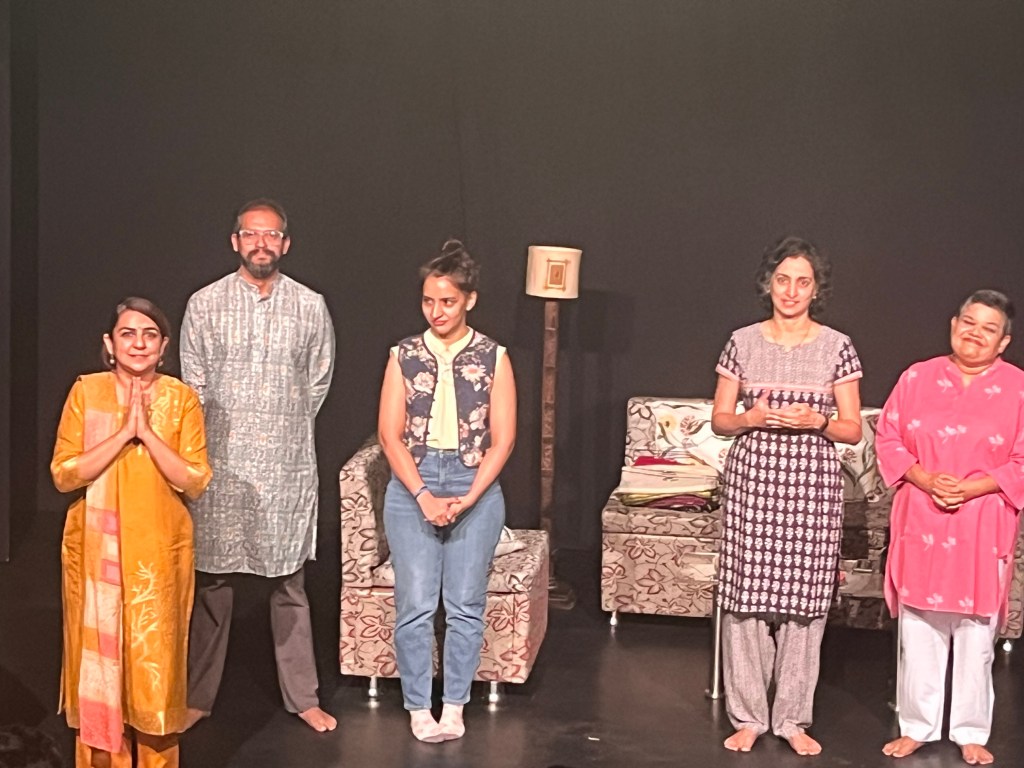
The Crew – Deepa is 4th from the left and Seema – who plays her alter-ego is 5th from the left
 Incorrigibly romantic ...