Book Review:
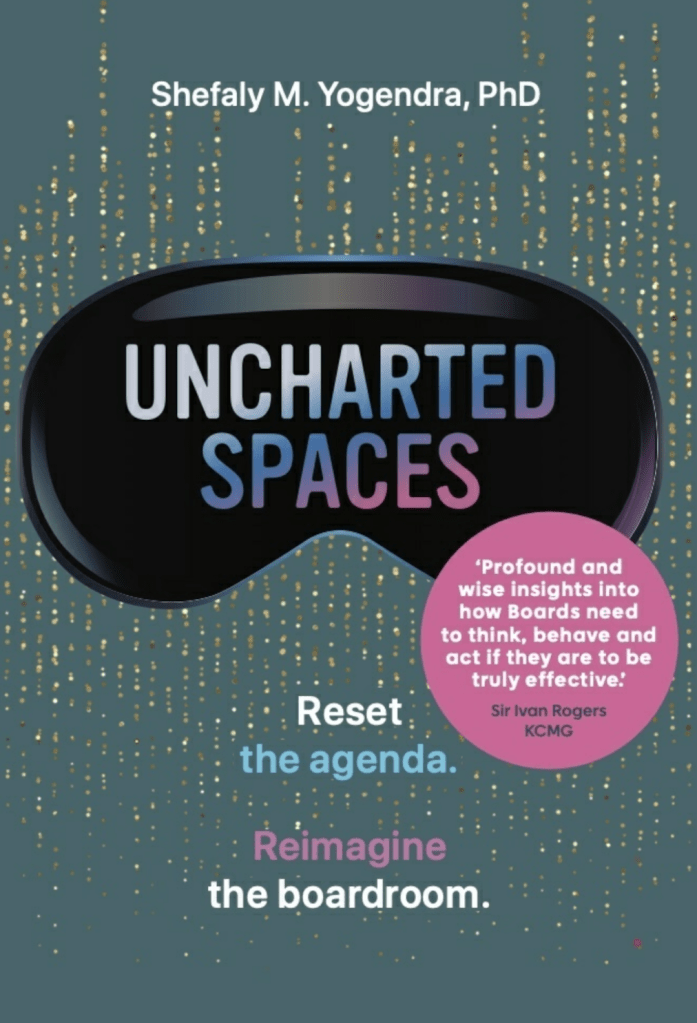
Uncharted Spaces: Reset the Agenda Reimagine the Boardroom by Shefaly Yogendra
Introduction
It was with great anticipation that I picked up this book written by Shefaly Yogendra – a batchmate from WIMWI, and I was not disappointed. The book speaks of emergent dynamics in company boards and its incumbents that get divided by a sharp and yet subtle line – the promoters and the executive directors on one side and the independent directors, who are mandated by most countries today to act on behalf of shareholders and key stakeholders on the other.
I must confess my own experience as a board member is extremely limited to a few unlisted firms and a not-for-profit organization centered on group dynamics and process work, where I am either a co-founder or have worked my way up to the board. In the past, I have avoided all feelers and invitations to join any board of directors as an independent director partly because I never had the courage to take on this role and partly because I was not ready in terms of competencies.
The book by Shefaly is a good read for anyone who is intrigued by how a ‘board of directors’ interfaces, influences, audits, and collaborates with managers across a typology of organizations on many a front – this interest, o reader, could be experientially visceral where you assume the membership of the board, or could be aspirational as you choose to let go of your CXO responsibilities and look forward to being an independent director, or even academic – two dear friends chose their doctoral research on this sub-system, as it gains more visibility and criticality in organization dynamics.
I met Shefaly a few months ago, and after a gap of 32 years, and she still radiates the intense vim around her, the chutzpah, the wit, and the intellectual sharpness that I associated with her many years ago in the campus. It was indeed a memorable conversation around many themes – on writing and launching a book, on her PhD on decision making in Cambridge, teaching, and her gendered lens of looking at Indian society – all of this I vibed and resonated with. It was this conversation that spurred me to pick her book.
Part 1
The Indian Context – The Demand for Independent Directors
Across the globe, corporate governance frameworks including OHADA are laying an emphasis on the role of the ‘Independent Director’, underlining the need for this class of leaders to play ‘impartial gatekeepers’ that not just manage and mitigate vested conflicts in boards, but safeguard minority shareholders and build investor confidence.
The independent directors are further saddled with demands of expertise on areas such as ESG, cyber security, risk management and digital transformation, and all of this at the cost of heightened personal liabilities. In India, it is mandated that 1/3rd of the boards as per Section 149 of Companies Act 2013 should comprise of independent directors.
As on date, there are approximately 8,000 individuals that hold independent directorships for companies listed on National Stock Exchange (NSE) in India – this number as seen rising attrition and churns as independent directors feel the heat and the burden of pioneering tough and challenging themes.
According to the Official Independent Director’s Databank, there are close to 22,000 registered individuals who are eligible to take on the roles of independent directors, of which there are 6,000 registered independent directors.
India currently faces a functional shortage of qualified board members. With approximately 45,000 to 50,000 eligible public and unlisted corporate entities legally required to meet the 1/3rd board composition quota, corporate demand is projected to push India’s requirement to over 1,00,000 independent directors by 2030.
Given this growing demand-supply gap for independent directors, in a country that has also witnessed increasing crony capitalism, volatility, and corruption, as India strives to grow into a global superpower, I think Shefaly has timed her book perfectly for the Indian readership.
Part 2
Her Writing: Leveraging a Personal Journey
Shefaly Yogendra offers her narrative as a scaffolding for the nuggets of wisdom she seeks to unleash and offer to the reader. She begins by unabashedly emphasizing on how two of her personal strengths prepared her for this journey towards ‘becoming’ an Independent director – that of Patience and Curiosity.
Her experiences are laced with subtle humor which are then structured into concrete insights and learnings. Her language and slant are most suited for the global reader, who has to be a savant of some order – understand the world of systems thinking (and value weltanschauung), who has been influenced by complexity theory and its insights, and have an innate curiosity into the emerging technologies including AI. But Shefaly also underlines her own experience of a flaneur for lack of better words, as she takes you across her journeys in UK and Europe, yet endorsing some of her views through specific Slokas from Bhagwat Gita.
I particularly loved some of her metaphors. She defines governance as a ‘contact sport’ – the metaphor hits you viscerally if you have played contact sports. She offers lines from some of my favorite poets including Kipling’s ‘If’ to illustrate role-taking within Boards and quotes from Tolstoy to speak of dynamics or an old Pink Floyd number on Money.
The book moves quite linearly – the initial chapters speak of preparing for the role of the independent director, to the selection and onboarding process, to settling down into the system, to working with dissent, conflict, and dysfunctional politics within the Board, to taking on specific assignments and interventions that build the firm’s future. Scanning the geo-politics of the context and exploring alliances and neural networks becomes her work on strategy for boards.
What I liked about the beginning is the stress on “why” before kickstarting the process of comprehending the journey. In each chapter, Shefaly as stated earlier, crystallizes an insight or a nugget that you are tempted to underline and make a note for yourself, without becoming patronizing.
While I am tempted to go into details of the book, I choose not to for it would be unfair to the author. I would rather emphasize on what of her writing resonated with my understanding of Organizations as living systems – where culture, identity processes, system psychodynamics, and transformation become important. Shefaly speaks of the importance of how discerning and working with current culture within the system becomes critical for the independent director. She underlines the ability of the incumbent independent director to walk through the minefield of egos, of politics, and of unconscious resistance to any change mandate. She points to unconscious processes of ‘groupthink’ (or basic assumptions one-ness and pairing) that are seductive despite the dharma of offering independent views and judgments.
In the last two chapters, she underlines the need to be courageous, as one must scan the emerging landscape of geopolitics that impact global supply chains or costing models, or new markets … to take stances and decisions amidst volatility and uncertainty. It is this forward-looking demand of the independent director that she emphasizes on and offers her insights into this process.
Part 3
The Critique
This section becomes difficult for me as there is very little ‘experiential overlap’ when it comes to the subject area – I feel, and rightly so, quite ignorant when it comes to critiquing the content of the book. However, I do have some questions for myself as a co-founder, and as an OD practitioner. Given that the book has been both evocative and provocative – these questions may build further understanding of the reader.
Question 1
Is the independent director a victim of the proverbial ‘set-up’ and the ‘last person’ standing up against the dark shadows of capitalism?
The more I read about independent directors, the more concerns I carry on the role-expectations and the burdens that men and women carry when they assume this role. On paper, corporate governance is the primary burden and it demands providing unbiased oversight, strategic guidance, and objective judgment – and all this with ethical conduct and independent judgment.
The metaphor that I offer is of the ‘noblesse-oblige’– where amongst the corrupt and failing medieval feudal systems, there were some knights in the shining armor (quite literally), who had to stand for social responsibilities and towards the victimized peasantry … in reality this stance was quite farcical, for no amount of noblesse oblige could wipe out the inherent flaws of hegemony, exploitation, and corruption in the system.
The question that I carry is perhaps of similar nature – is the independent director being set up for failure (and with a quixotic slant) – with tremendous burdens to transform not just the boards of firms but organizations and perhaps when the rest of the system seem blind, uncaring, myopic, greedy, narcissistic, and hegemonic to many of the issues. Are we expecting too much from the independent directors? The only resource that may help the Independent director is ‘Courage’ – and there seems to be a short supply of this precious trait.
The rising attrition of independent directors in specific industry verticals of IT and manufacturing in India does signal to the trend that the role has huge challenges and accompanying liabilities that a professional may not wish to take on. Resignations by independent directors (IDs) from listed companies in India hit a five-year high of 668 exits in FY26, reflecting a 15% increase from 564 in FY25 and a 25% surge from 530 in FY24.
Do we need to create a better safety net – re-calibrate legal protection and indemnities for these men and women?
Question 2
How do we create and sustain ‘Independence’?
Shefaly emphasizes on and examines what an independent mindset may imply, and I have no disagreements with her on what she has written.
However, I do know that groupthink is an unconscious process and so are basic assumptions identified by Tavistock thinkers, and how cultures overwhelm diversity in thought and independent stances. There is an offering by Tavistock Institute of Human Relations called as “Dynamics at Board Level” where the focus is on seeing the boardroom as a complex human system impacted by unconscious forces.
What may be happening that the class of CXOs and CEOs that are retiring today – may get inspired by wanting to become independent directors, and when inducted into an existing board, may bring in lens and worldviews that may mirror the others – promoters and executive directors. Thus, it becomes an important question to mull over – does sustaining independence also mean fishing beyond the familiar seas and oceans of the corporate sector, business schools, and entrepreneurs?
Question 3
Is there a seduction of the myth of becoming Omniscient and then Omnipotent – in the hidden rivalry between promoters and independent directors?
Vey often promoters believe that they know it all when it comes to business – it becomes difficult to state one’s ignorance, and all-knowing leads to a sense of power. The incumbent independent director must confront and challenge such stances for these create waste in the system.
However, the book does lead to an impression that access of new data and analytics can augment the power of the independent director – fact finding missions becomes key to gaining legitimacy and power. It is almost as if the independent director must discover new trends and patterns to be able to challenge and influence the system. I wonder whether this allegiance to omniscience being the only source of power for the independent director, leads to dysfunctional politics. For example, what kind of rivalry gets unleashed if the above is true.
So, when does the Independent Director leverage the gut and the heart becomes an interesting question to pursue as you peruse through the book. If Shefaly was willing to write a book for the Indian audiences alone – I would have invited her to look at the notion and construct of ‘dharma’ and how it relates to the organization, the management, the board, and the independent director role.
Part 4
Conclusion
This blog has gotten delayed by a fortnight – I have tossed and turned and made many changes to how it flows and stalls, for the area of enquiry is new to me. But I have truly enjoyed reading this book by Shefaly. As Foucault had emphasized on – new knowledge drives new power transitions – I think Shefaly’s writing would spur many people to take on the role of the Independent Directors and perhaps shift the nature of power and dynamics within a powerful sub-system.
I am also left some regret that I did not know her that well in the campus three decades plus ago. In the last three months, I have written two book reviews – the first book was co-authored by S Ramesh who looks at the world of CEOs and CXOs and their leadership journeys, and the second book is by Shefaly who writes on Independent Directors. Both Shefaly and Ramesh have been batchmates, and it has been a wonderful opportunity to read their respective offerings and experience a different connect.

