Introduction
This blog explores the hues and nuances of a complex archetype – the trickster-seeker, as immortalized by Pulin K Garg in his tale of four princes, and leverages Christopher Nolan’s rendition of the Odyssey as a backdrop. For movie fans, there are not many spoilers – the epic even in Nolan’s film has no real surprises in terms of the ordeals and the adventures save a few twists.
Granted that Odysseus is a warrior-lord and King from Ithaca, and that there are clear references to other archetypal energies within, I still see the narrative as an internal voyage for the trickster-seeker within.
I would also like to state that while I am a big fan of Nolan’s works, I was quite disappointed with his version of Odyssey and as you read the blog – you may empathize with my feelings.
Odyssey: The Narrative as a canvass
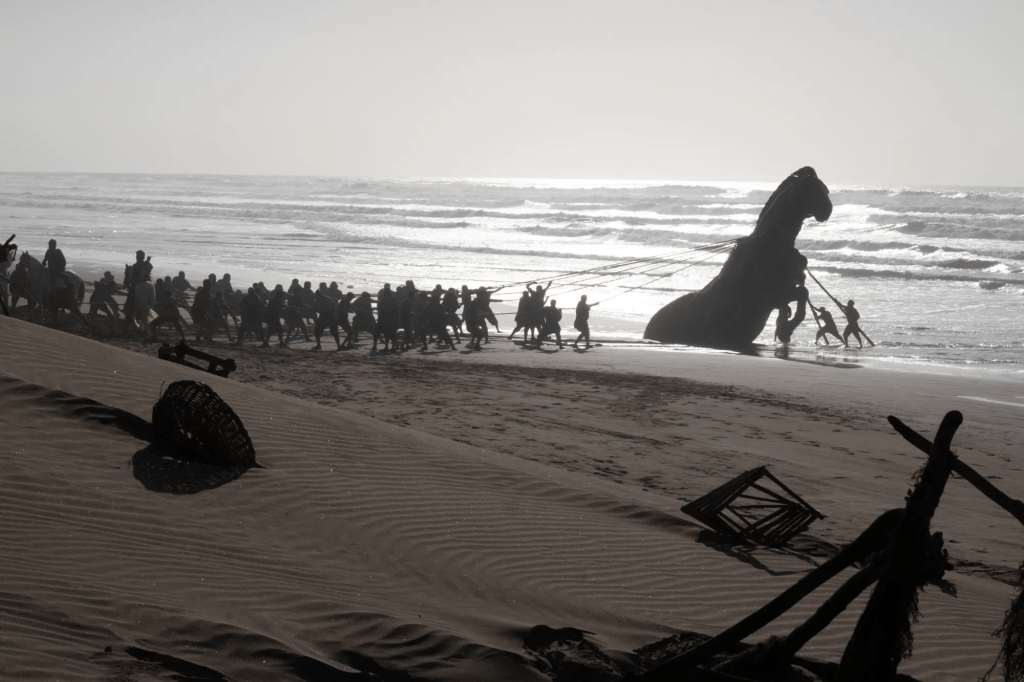
The long voyage from Troy back to Ithaca, where after having masterminded a cunning and deceitful ploy of the Trojan Horse, Odysseus witnesses if not participates in the rampant destruction and mass-scale murdering of men, women, and children of a city-kingdom of Troy, sets off on a metaphorical journey.
The monsters filled sea and islands become the unconscious mind, and the series of challenges, obstacles, and unrelenting conflicts can be seen as the maturation of Odyssey’s identity as he works with trauma and painful growth.
Odysseus in the beginning of the narrative is a hubris-driven warrior who can resort to trickery and cunning with ease, and his adventures, suffering, mistakes, and ordeals allow for growth – he becomes wiser, humbler, and grows.
The Hero
In the Greek epics, a hero is not a moral role-model but a flawed larger than life figure, who suffers intense, extreme, and volatile pain (ados) in the pursuit of glory or Kleos – and thereby gets spoken of through songs and stories long after his death.
Just like Achilles who is the flawed Warrior Hero driven by physical and brute force that leads to domination on the battlefield, is doomed to a tragic death, Odysseus is the Metis (Trickster / Cunning) Hero who achieves glory by not dying but by surviving the bleakest and most terrifying journey to his home.
The Fourth Prince by Pulin K Garg
Pulin wrote an incomplete tale around four princes – each prince immortalizes a Jungian archetype that is spoken of in the book – King, Warrior, Magician and Lover by Gilette and Moore. Pulin’s brilliance lies in evoking complex symbols that energize the Archetype, and more so in asking the listeners to take the tale forward into their own lives. In the past I have written many a blog on each of the archetypes.
The fourth prince archetype is much richer than the Magician by Gilette and Moore, for Pulin brings in nuances of the Seeker, the Nomad, the Trickster, and the Joker as well as emphasizing on transformative journeys within for this archetype – journeys that symbolize the re-birthing of the energy as it experiences maturation. Pulin brings in interesting symbols of violent suffering (the stick), of the seduction to stay cunning, as one copes with the challenges of uncertainty and living.
Perhaps the only struggle that Pulin has is to offer exemplary characters from Indian epics – the other three have many a reference but the trickster / seeker identity has not many takers. It is here that Odysseus becomes a rich metaphor that can map the complexity of the archetype and where his journey allows for discerning and defining many of his inner transformations and maturations.
The Journey within and the Islands
While the monsters filled oceans may represent the unconscious, each island where Odysseus lands and gets to confront or suffer an adventure becomes a threshold – the threshold often symbolizes a defense mechanism and a call to engage with its demands and meted punishments.
Odyssey leaves Troy with unexamined or unconscious guilt – the Trojan Horse maneuver is seen as a great ploy that brought a bloody battle of ten years to a close (with a massacre of innocents) – and it is worthy of many a song back home.
However, Odysseus is indeed traumatized and emotionally empty as he tells his crew that he would not take the known route back home – which others including Agamemnon choose as they go home celebrating victory. It is this initial stance that signals to a moral injury and ‘bloodguilt’, as his trusting seafarers listen to him, and commence a journey of death. Perhaps Odysseus is not ready to go home for he is tainted and broken within.
Island 1: The Island of Cicones
The first island that Odysseus and his 12 ships come to is the city of Ismarus on the island of Cicones. Given that Cicones were allies of Troy, Odysseus orders his men to sack the city, kills its men, and take the women – a ruthless habit of plunder that 10 years of war with Troy had normalized for him and his men.
Flushed with the historic win at Troy and how this victory boosted egos and vanities, the men of Odysseus demand to stay an extra night on the island (despite Odysseus’s command to leave immediately) – drinking and celebrating their sacking of Ismarus on the beach.
The morning comes with a counter-offensive from Cicones, and Odysseus and his men are forced into a chaotic, bloody retreat – the illusion of wartime omnipotence seeded in the fall of Troy becomes the first illusion to be shattered, as Odysseus loses many men. There are many who see this retreat as a metaphorical conflict between the rational mind (Odysseus) and the Id (his crew), and how this fragile balance gets its first hit on the island of Cicones.
I see this island representing the first of the pendulum swings from omnipotence to impotence – an oscillation that is both humiliating and humbling. Odysseus is also aware that his choice making and meaning making is currently driven by the Warrior’s cruelty and lust for battle.
There is no real healing at Cicones and nor there is an repentance except the awareness of the itch to destroy, plunder, rape, and kill – a primal gratification of urges that makes us beasts and monsters within.
Island 2: The Islands of Lotus Eaters and Calypso’s Ogygia
Christopher Nolan merges two islands into one and where Calypso and her island represents the deep desire to escape from the anxieties of taking responsibility over intended and unintended consequences of one’s actions.
In the original text, the island of lotus eaters offers an ‘escape’ from trauma and painful memories. In the film, Odysseus spends seven years on Ogygia held captive by a goddess Calypso – her name literally means ‘to conceal or hide’.
Calypso in Nolan’s version has Odysseus stripped of his memory, his agency, and his identity as he discovers a comforting stagnation quite like the womb on Ogygia – where he is loved and possessed by a goddess who promises him immortality.
In many ways, the island stands for choosing numbness (drugs / alcohol / escapism) over the painful growth required by life. And many a fourth prince never seem to find a way out. Calypso, perhaps representing the ‘static feminine’ offers nothing to Odysseus except a growing resentment that he would leave one day. In the original text, Calypso is forced by Zeus to release Odysseus – she resents this directive for male Gods could keep mortal women as consorts and expresses her ire at this gender inequity.
Odysseus is asked to put faith in a fragile raft and surrender to the Ocean (Poseidon) if he wishes to escape – and so commences a solitary journey of sheer surrender.
Island 3: The Island of the Cyclopes and the tryst with Polyphemus
Nolan’s film does not do justice to the travails and suffering of Odysseus and this part of the film is quite disappointing.
In the original text, Odysseus and his 12 men explore Polyphemus on the island of Cyclopes. They enter a cave and discover that Polyphemus lives there and who later traps them inside with his sheep. Odysseus devises a cunning plan – he offers Polyphemus a highly potent wine that gets the giant into a drunken stupor. Delighted the drunk giant asks Odysseus for a name and Odysseus famously replies – My Name is Nobody (Outis)
Once Polyphemus passes out, Odysseus shoots the giant in the eye and the giant screams in agony. Other Cyclopes come outside Polypehmus’s cave only to hear him screaming that “Nobody is killing me”. They go away believing that Polyphemus is suffering from a divine affliction. The next day, Odysseus and his men make an escape by clinging to the belly of the prize rams.
Once safely on his boat, Odysseus is consumed by pride and hubris, and he shouts back his name – Odysseus, raider of cities, son of Laertes. Polyphemus prays to his father – Poseidon who invokes a terrible curse that ensures a treacherous journey and the death of all his men.
While Nolan’s Odyssey does not highlight some of the tale, Polyphemus is much more of a monster. In many ways, his single eye makes him look at the world one-dimensionally – he does not see the world with nuances. He symbolizes a primitive and raw part of us that is driven by appetite alone without empathy or logic.
To defeat this brutish monstrous force – a selfish ego that devours others, it required the warrior to deflate his own ego – to become a “nobody” – Odysseus tragic mistake was that he could not keep remain anonymous and shouted out his real name to get the wrath of the unconscious. This was an act of hubris – an act of disappearing and appearing as the fourth prince that Odysseus gets to be a captive of and an act that had tremendously dark consequences.
Island 4: The Island of Aeaea and the tryst with Circe
Nolan brings this adventure alive and the film highlights how Circe pampers men into becoming passive beasts choosing comfort over painful self-actualization. Circe uses a magic potion to strip Odysseus’s men of their reason and transforms them into pigs – she essentially channels their repressed animalistic desires of greed and lust.
Most analysts believe that Circe stands for the Anima – the unconscious feminine side of a man’s psyche in its predatory and devouring form. She is supposed to strip men of their manhood and of their autonomy and become subservient to emotions.
It is also believed that Circe represents a threat to the patriarchal world of men as she emerges as a powerful and autonomous woman.
Again, while Nolan does not depict it so, but in the original text, Odysseus only defeats Circe because he has the moly – a magical herb that represents rational awareness and boundaries of discipline and morality (static masculine) and it is the moly that allows Odysseus to tame Circe. Circe transforms into a vital ally from a predatory monster – she provides many a gift to Odysseus including the roadmap and directions to the Underworld, and the journey through the Sirens.
Perhaps it is important to distinguish two powerful feminine forces – that of Calypso and of Circe – maybe it merits another blog. But suffice it to say, the first force is to be fled from (the possessiveness of the static feminine that offers the stagnant womb and the promise of eternity through numbness without pain) and the second force is to confront and integrate – the devouring dynamic feminine that needs personal mastery for it to become an ally.
The fourth prince by Pulin is doomed towards self-sabotage and till he learns to manage the stick (or integrate the moly) – the archetypal energies are directed towards escapism, greed, lust, and self-destruction.
Island 5: The Island of Scheria and the Transitional Space of Therapy
Nolan chooses not to depict this island – the island of Phaeacians.
In behavioral labs, process-work spaces, group relation conferences, and therapy sessions, Scheria becomes the transitional space between the unconscious and its fears and prizes and the real world out there (that of Ithaca).
In the original text, the Phaeacians act as compassionate witnesses to Odyssey’s realization of his trauma – they offer a space of healing and safety, where Odysseus weeps and invests into a space for catharsis. It is this catharsis that enables him to access his fragmentation within and still manage to create a coherent narrative for himself. Odysseus is washed ashore on this island – naked, battered and near death and experiences deep sleep symbolizing a re-birth.
The core of psychoanalysis is putting repressed, unspeakable trauma into a structured narrative. On Scheria, Odysseus transitions from a passive victim of fate to the active author of his own life. By speaking his trauma aloud to an empathetic, non-judgmental audience (the Phaeacians), he integrates his fragmented psyche.
The women of Scheria are neither like Calypso – who possesses and smothers or like Circe – who castrates – they represent a joyful feminine energy that heals Odysseus and allows for the integration of his Anima. Scheria turns out to be a transitional space as Poseidon stone walls it from the rest of humanity as the healers offer resources to Odysseus.
This is the space that is so critical for the fourth prince – for the trickster really encounters safety, non-judgmental compassion, and a sense of belonging.
The land of Nekuia: The Underworld
Though not an island, Nekuia represents the inner descent into the deep unconscious where Odysseus confronts repressed trauma and guilt and his own shadow, in his journey towards becoming a king from a cunning raider of cities.
Nolan does a good job here – depicting the mechanism of kickstarting this inner journey through the blood ritual (or the Cathexis) – a ritual where old memories that are disowned and denied are given attention and energy, forcing the individual to confront such memories. Odysseus has to confront figures and most notably his mother Anticleia – who died of heartbreak waiting for him, and Elpenor (his youngest crewman)– and it is these confrontations that break his defense mechanisms. In not being able to embrace his mother – it is the symbolic final severing of the umbilical chord, and in growing up
The conversation with Agamemnon is around the fear of Feminine – a toxic tale of paranoia that Odysseus has now to reject within – so that he can re-unite with his queen successfully. This conversation demands Odysseus to cleanse his own traumas and his bitterness with feminine energies.
Nolan does not look at the conversation with Achilles – but the original text speaks of how Odysseus has to cleanse his psyche of the seduction of kleos – or battlefield glory. Achilles tells Odysseus that he would rather be a dirt-poor slave on earth than the king of the dead. This conversation is the final cue for Odysseus to value his return where he belonged.
Lastly Nolan skips this part of Tiresias’s messages – Tiresias tells Odysseus to take an ‘oar’ and walk inland until he finds people who do not know what the sea is – and if the sea is a metaphor of Odysseus’s trauma – it means that it cannot be beaten or subjugated or erased – it can be only understood and laid in place of peace.
Conclusion
The Fourth Prince, as I have heard my elders state, suffers from a similar existential quest that beckons suffering and pathos if these questions are not answered.
The first question is that of “where do I belong?”
Odysseus’s inner journey is that of discovering ‘nostos’ – a blissful feeling of returning home. All seekers and wanderers would identify with this question. Does Odysseus actually reach home – this question is kept open in Nolan’s work – as he sails with his wife into the western world to atone for his guilt and the killing of crewmen like Elpenor
The second question is that of “Am I substantive enough?”
The epic offers many an insights to this question including the seduction of wanting to be the Warrior (the deflation of the warrior ego), the escape from owning consequences of one’s actions.
I would leave you to examine these gifts for yourselves for the epic offers several.
Lastly the fourth prince identity and its complex hues do not resonate with much of the Indian text or interpretation of its epics.

